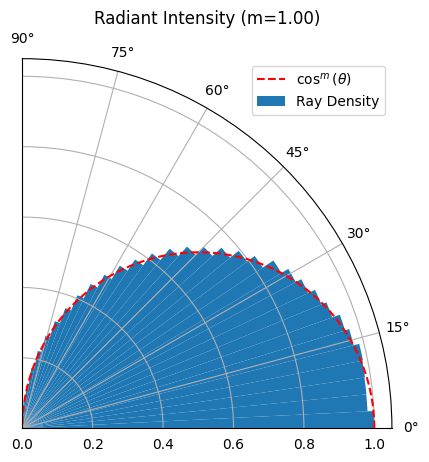
In this section I demonstrate how I model the radiant transfer of energy from the LED using Monte Carlo ray tracing.
from dataclasses import dataclass

import matplotlib.pyplot as plt
import numpy as np
from optiland.rays.real_rays import RealRays
LED Specs
The LED in this project is a Thorlabs M450 LP2 LED. The key specs are:
Wavelength: 450 nm
Bandwidth: 18 nm (FWHM)
Emission area: 1.5 mm x 1.5 mm
Radiant flux: 3 W
Viewing angle: 120 degrees
From a Radiometric to a Probabilistic Model
Viewing Angle and the Lambertian Order
The most important quantity for modeling the LED is the radiant intensity. (If you’re not familiar with radiometry, intensity is the power per solid angle, not per area.) For this I chose a cosine-power law model as a function of the angle with respect to the optical axis:
Strictly speaking, the intensity depends on the azimuthal angle as well, but I assume that the intensity is symmetric about the axis so that the dependence on disappears from the expression. The exponent is known as the “Lambertian order” and is determined by the viewing angle as follows.
Half the viewing angle is the angle at which the intensity drops to half of its maximum value. This happens at for this LED. The value for is determined by the expression:
Solving for gives:
Spatial and Solid Angle Sampling
The next step is to create an algorithm to generate ray starting locations and angles such that their distributions match the physical model for the LED.
I start with two assumptions:
Every point on the emitter surface has the same Lambertian emission pattern, .
The radiance is azimuthally symmetric and constant in x and y.
The total power emitted by the LED is the integral of the radiance over the area of the emitter and the solid angle.
appears because the differential solid angle in spherical coordinates is proportional to . appears from the definition of radiance and accounts for foreshortening of a source patch when viewed at an angle. and are the lengths of the rectangular emitter area.
The term that appears in the integral of (4) implies that we should let . Carrying through the integration over and would leave the radiant intensity inside the integral, and this I know should be . As a sanity check on this reasoning, consider that an ideal Lambertian emitter has and constant radiance; replacing with indeed leads to a constant radiance over when .
I next assert that if each ray carries equal power , then the number of rays emitted from a differential region should be proportional to the power emitted from that region. This leads to a probability distribution:
Integrating over this distribution gives:
More generally, since , , , and are independent random variables:
Let , , and be uniformly distributed over , , and , respectively. Then I have
where is a normalization constant that ensures integration of over is equal to 1. Comparing equations (4) and (8), and noting that the number of rays is proportional to the emitted power, I find that
Integrating over , , and :
It remains to
determine the normalization constant, and
sample from the above probability distribution function to generate the ray starting positions and angles.
Finding the Value of the Normalization Constant
Use substitution of variables with and .
Finally, I have the expression for the p.d.f. in :
Inverse Transform Sampling of 
To sample from this probability distribution function, I use standard inverse transform sampling. In this approach, I draw a uniformly distributed random variable between 0 and 1, then find for the corresponding value of for which the cumulative distribution function (c.d.f) is equal to .
The Cumulative Distribution Function 
I solve this using substitution of variables with and . The calculation is straight forward.
Random Variates Distributed as 
Let be a uniformly distributed random number between 0 and 1. Its c.d.f. is just . Then, equating the c.d.f.'s for the uniform random variate and for :
Solving for leads to the desired expression:
This is the key to simulating random numbers for the ray directions that are distributed according to the intensity model of the LED. I draw uniform random numbers , transform them using equation (20), and the results are distributed according to equation (16).
Ray Generation Algorithm
The following code implements the approach described above.
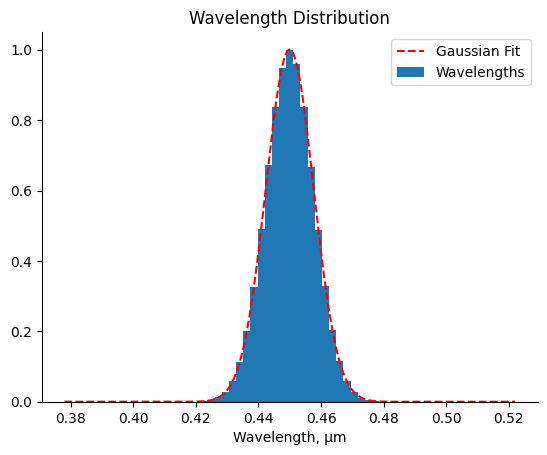
Note that I have to transform the ray directions in spherical coordinates into the corresponding direction cosines. I also randomly generate wavelengths according to the bandwidth of the LED.
@dataclass
class LED:
    length_x_mm: float = 1.5
    length_y_mm: float = 1.5
    viewing_angle_deg: float = 120.0
    center_wavelength_um: float = 0.45
    fwhm_wavelength_um: float = 0.018

    def lambertian_order(self) -> float:
        """Compute the Lambertian order of the LED from its viewing angle."""
        theta_half_rad = np.deg2rad(self.viewing_angle_deg / 2.0)
        m = -np.log(2) / np.log(np.cos(theta_half_rad))
        return m

    def generate_rays(self, num_rays: int, power_watts: float = 3.0) -> RealRays:
        x_min, x_max = -self.length_x_mm / 2.0, self.length_x_mm / 2.0
        y_min, y_max = -self.length_y_mm / 2.0, self.length_y_mm / 2.0

        # Random starting positions on the LED surface
        x, y = np.random.uniform(x_min, x_max, num_rays), np.random.uniform(y_min, y_max, num_rays)
        z = np.zeros(num_rays)

        # Random directions based on generalized Lambertian distribution
        u, phi = np.random.uniform(0, 1, num_rays), np.random.uniform(0, 2 * np.pi, num_rays)
        theta = np.arccos((1 - u) ** (1 / (self.lambertian_order() + 1)))

        # Direction cosines
        l = np.sin(theta) * np.cos(phi)
        m = np.sin(theta) * np.sin(phi)
        n = np.cos(theta)

        # Ray intensities
        watts_per_ray = power_watts / num_rays

        # Wavelengths
        wavelengths_um = np.random.normal(
            loc=self.center_wavelength_um, scale=self.fwhm_wavelength_um / 2.355, size=num_rays
        )

return RealRays(x, y, z, l, m, n, watts_per_ray, wavelengths_um)num_rays = 1_000_000
led = LED(viewing_angle_deg=120.0)
rays = led.generate_rays(num_rays=num_rays)
num_bins = 32
bins = np.linspace(0, np.pi / 2, num_bins, endpoint=False)
bin_centers = 0.5 * (bins[1:] + bins[:-1])
width = bins[1] - bins[0]
theta_rays = np.arccos(rays.N)
counts, _ = np.histogram(theta_rays, bins=bins)
solid_angles = 2 * np.pi * (np.cos(bins[:-1]) - np.cos(bins[1:]))
density = counts / solid_angles / num_rays
# Normalize to 1
density_normalized = density / density.max()
ax = plt.subplot(projection='polar')
ax.bar(bin_centers, height=density_normalized, width=width, bottom=0.0, align="center", label="Ray Density")
# Plot cos^m distribution for comparison
theta = np.linspace(0, np.pi / 2, 1000)
m = led.lambertian_order()
ax.plot(theta, np.cos(theta)**m, color='red', linestyle='--', label="$\\cos^m(\\theta)$")
ax.set_thetalim(0, np.pi / 2)
ax.set_title(f"Radiant Intensity (m={m:.2f})")
plt.legend()
plt.show()
Ray Azimuthal Directions
Are the ray directions uniformly distributed in the azimuthal dimension?
#Are the ray directions uniformly distributed in the azimuthal dimension?

phi_rays = np.arctan2(rays.M, rays.L)
num_bins_azimuth = 32
bins_azimuth = np.linspace(-np.pi, np.pi, num_bins_azimuth + 1)
bin_centers_azimuth = 0.5 * (bins_azimuth[1:] + bins_azimuth[:-1])

counts_azimuth, _ = np.histogram(phi_rays, bins=bins_azimuth)

# Normalize to 1
counts_azimuth_normalized = counts_azimuth / counts_azimuth.max()
width_azimuth = bins_azimuth[1] - bins_azimuth[0]

ax = plt.subplot(projection='polar')
ax.bar(bin_centers_azimuth, height=counts_azimuth_normalized, width=width_azimuth, bottom=0.0, align="center", label="Ray Azimuths")

ax.set_title("Ray Azimuthal Direction Distribution")
plt.show()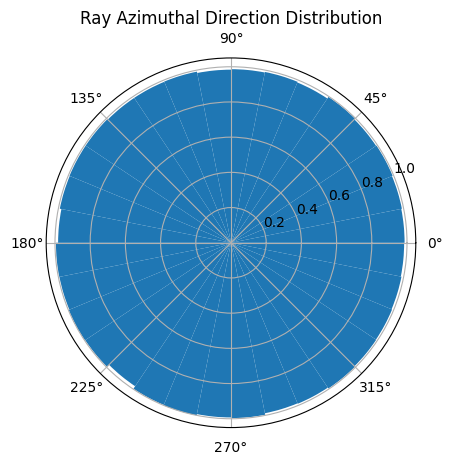
Ray Starting Positions
Are the ray starting positions uniformly distributed across the emitter surface?
x_positions = rays.x
y_positions = rays.y

num_bins = 32
x_bins = np.linspace(-led.length_x_mm, led.length_x_mm, num_bins)
y_bins = np.linspace(-led.length_y_mm, led.length_y_mm, num_bins)
plt.hist2d(x_positions, y_positions, bins=[x_bins, y_bins], density=True)
plt.xlabel("x, mm")
plt.ylabel("y, mm")
plt.title("Ray Starting Position Distribution on LED Surface")
plt.colorbar(label="Density")
plt.show()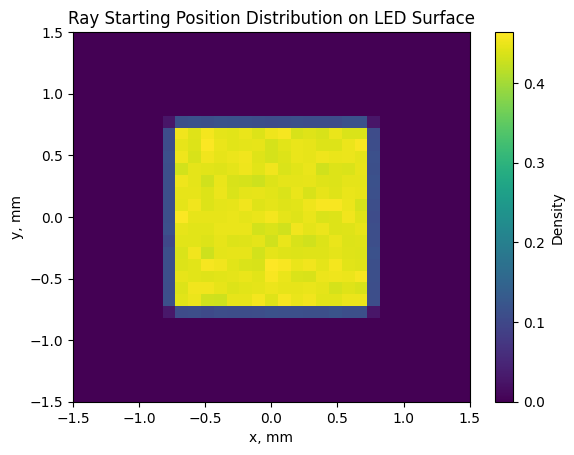
Are the wavelengths distributed according to a Gaussian distribution with the correct FWHM?
wavelengths_um = rays.w

num_bins_wavelength = 64
wavelength_bins = np.linspace(
    led.center_wavelength_um - 4 * led.fwhm_wavelength_um,
    led.center_wavelength_um + 4 * led.fwhm_wavelength_um,
    num_bins_wavelength,
)
wavelength_bin_centers = 0.5 * (wavelength_bins[1:] + wavelength_bins[:-1])
width_wavelength = wavelength_bins[1] - wavelength_bins[0]

counts_wavelength, _ = np.histogram(wavelengths_um, bins=wavelength_bins)
counts_wavelength_normalized = counts_wavelength / counts_wavelength.max()

ax = plt.subplot()
ax.bar(wavelength_bin_centers, height=counts_wavelength_normalized, width=width_wavelength, bottom=0.0, align="center", label="Wavelengths")

# Plot Gaussian distribution for comparison
sigma_um = led.fwhm_wavelength_um / 2.355
wavelengths_fit = np.linspace(
    led.center_wavelength_um - 4 * led.fwhm_wavelength_um,
    led.center_wavelength_um + 4 * led.fwhm_wavelength_um,
    1000,
)
gaussian_fit = np.exp(-0.5 * ((wavelengths_fit - led.center_wavelength_um) / sigma_um) ** 2)
gaussian_fit /= gaussian_fit.max()
ax.plot(wavelengths_fit, gaussian_fit, color='red', linestyle='--', label="Gaussian Fit")

ax.set_title("Wavelength Distribution")
ax.legend()

ax.set_xlabel("Wavelength, µm")
ax.spines['top'].set_visible(False)
ax.spines['right'].set_visible(False)
plt.show()